Hello everyone — I’m genuinely happy to welcome you into my studio. Grab a cup of tea, get cozy, and let’s talk about why we make art.
When a child picks up a pencil, a paintbrush, or a lump of clay, something magical happens. Without overthinking it, they bring feelings to life. A wobbly line can be excitement. A bright yellow circle can be comfort. A messy scribble can be a storm inside their chest. Lines, colors, and shapes aren’t “just” lines, colors, and shapes — they’re emotions with a heartbeat.
If you ask a child, “Why did you draw this?” the answer is usually beautifully simple. “Because I love the sun.” So they paint the sun. “Because I love my dog.” So they make a dog. That’s it. No performance. No comparison. No pressure. Just truth.
And here’s the part adults forget: that need doesn’t disappear when we grow up.
Some people make art for a living. Some make it to breathe again after a hard day. Some make it because words feel too small, too tangled, too heavy. But in so many different ways, we create for the same reason: to express ourselves — to make the invisible visible — to let our voice exist in the world.
Sometimes I feel empty. Not dramatic-empty. Just… quiet, hollow, like the color got drained out of me. And when I feel that way, I can’t even paint a straight line. (Honestly, I don’t even want to try.) Recently, I had a conversation with someone who asked me what “feeling empty” actually means. While I was trying to explain it, I realized I wasn’t finding the right words — but I could see it in my mind.
When the conversation ended, I went straight into my studio and painted what I couldn’t say. I titled the piece “Loneless.”
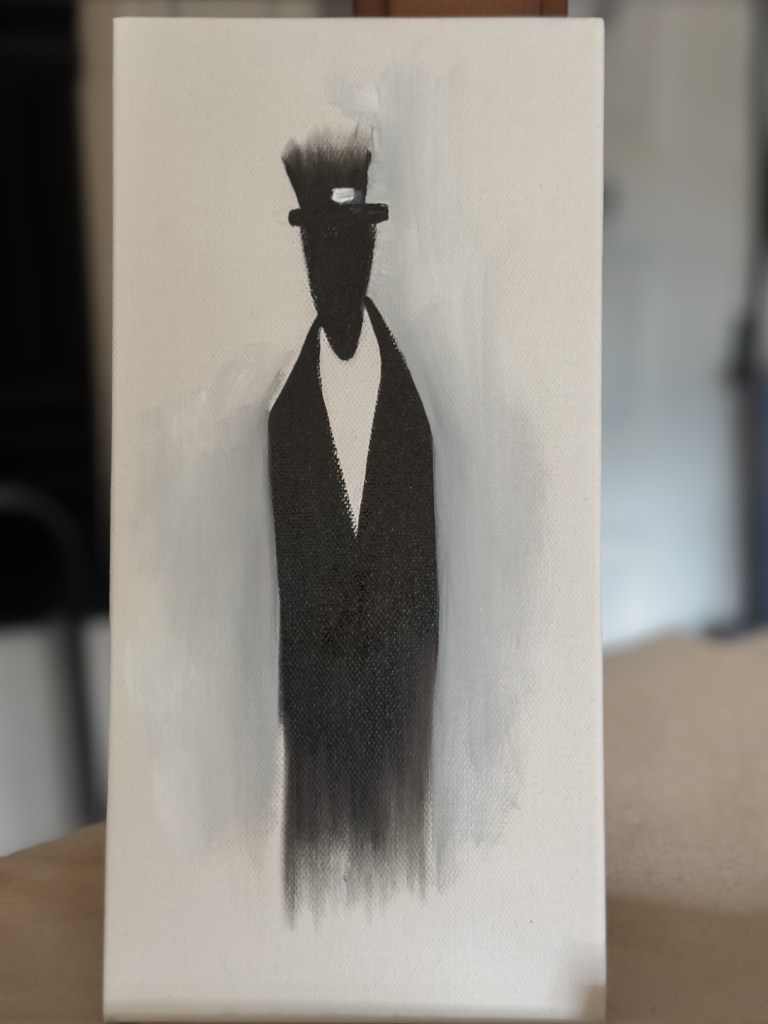
While I worked, I understood something important: when you feel empty, hurt, unseen — don’t retreat into your shell. Don’t swallow it. Don’t keep it quiet just because you think you shouldn’t feel that way, or because you’re afraid of being “too much.” Put it into art.
And please hear me on this part: don’t let the ugly little thoughts hijack the moment.
Not “I’m not an artist.”
Not “This isn’t good enough.”
Not “Someone online does it better.”
That’s not the point. That was never the point. Your art is your emotion. Your art is your voice. Your art is your proof of being here. And that matters more than perfect technique ever will. Make art when you’re sad or joyful. When you feel empty or overflowing. When you have only a few words, or when you could write a whole book. Make art to say, without apologizing: This is me.
 Victoria White Art Studio
Leave a comment