The First Woman Painter in History (And Why Her Story Matters)

Hey everyone,
I want to start a new conversation here on the blog—one that is incredibly close to my heart. We spend a lot of time talking about the day-to-day of running an art business, the joy of creating, and finding our voices. But lately, I’ve been thinking a lot about the women who paved the way for us to even have these conversations.
So, I’m starting a series about the women artists of history. And I want to kick things off with the absolute, very first woman painter whose name was ever written down.
We have to go way, way back for this one—to the 5th century BCE in Ancient Greece. I want to introduce you to Timarete.
Creativity in the DNA.
Growing up in a family of artists and musicians myself, I know firsthand what it feels like to have creativity just kind of woven into your DNA. You don’t just learn about art; you breathe it in from the people around you. Timarete’s story starts exactly like that.
In Ancient Greece, being a painter was a respected trade, but it was strictly a boys’ club. Women were expected to manage the home, full stop. But Timarete had a different kind of childhood. Her father was Micon the Younger, a very famous painter and sculptor in Athens.
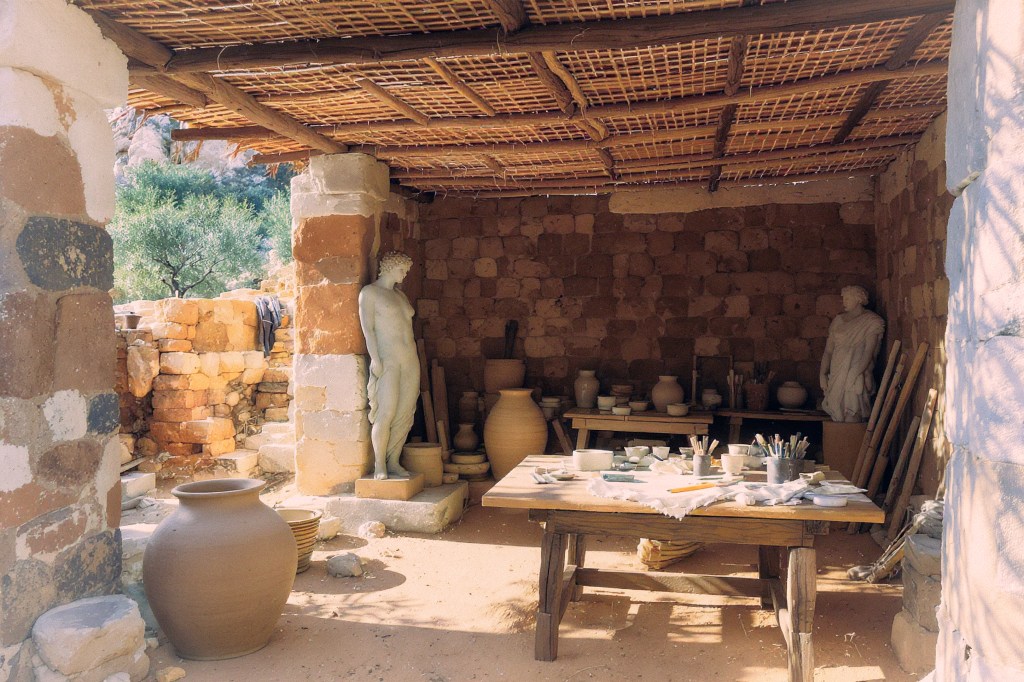
I’ve spent my entire life in and out of studios—from my earliest days painting to running my own home studio today—so I can vividly picture what her world looked like. Long before formal art academies, you learned by doing. I can just imagine her as a young girl, surrounded by the smell of raw pigments and binders, watching her father mix colors and work with clients. Instead of doing what society told her she “should” be doing, she picked up a brush.
The Masterpiece We Can’t See.
Here is the part of the story that breaks my heart a little bit as an artist: because Timarete lived roughly 2,500 years ago, none of her physical paintings survived. We can’t look at her brushwork, we can’t see her color palettes, and we don’t know exactly what her artistic voice looked like.
But we do know she was brilliant.
We know she existed because centuries later, the famous Roman historian Pliny the Elder made sure to write her name down. He recorded that Timarete painted a celebrated panel of the goddess Artemis, and that this painting was kept on public display at Ephesus—one of the absolute most important cultural centers of the ancient world.
Think about that for a second. She wasn’t just a hobbyist painting quietly in the corner of her dad’s workshop. She was a professional. She was creating work so powerful that it was displayed in a major public space and remembered hundreds of years later.

Breaking the Mold
Timarete represents something so beautiful to me. She was the first woman we know of who stepped up to the easel, learned the trade, and proved that talent doesn’t care about gender. She chose her own path.
As someone who is deeply passionate about the human-to-human connection in art, I find so much warmth in knowing that Timarete’s name survived. We might not have her painting of Artemis, but we have her legacy. She is the proof that women have been here, shaping the art world and running the business of creativity, right from the very beginning.
I hope you loved meeting Timarete as much as I loved sharing her story. Next time, we’re going to jump forward a bit in time to meet the first woman painter whose actual, physical artwork has survived for us to look at today. I can’t wait to share her with you!
Find me on:

 Victoria White Art Studio
Leave a comment